
Same tomorrow
the cafe
till: open. 07:10.
flat white: 12.20 (was 12.00).
noticed: 0 of 23.
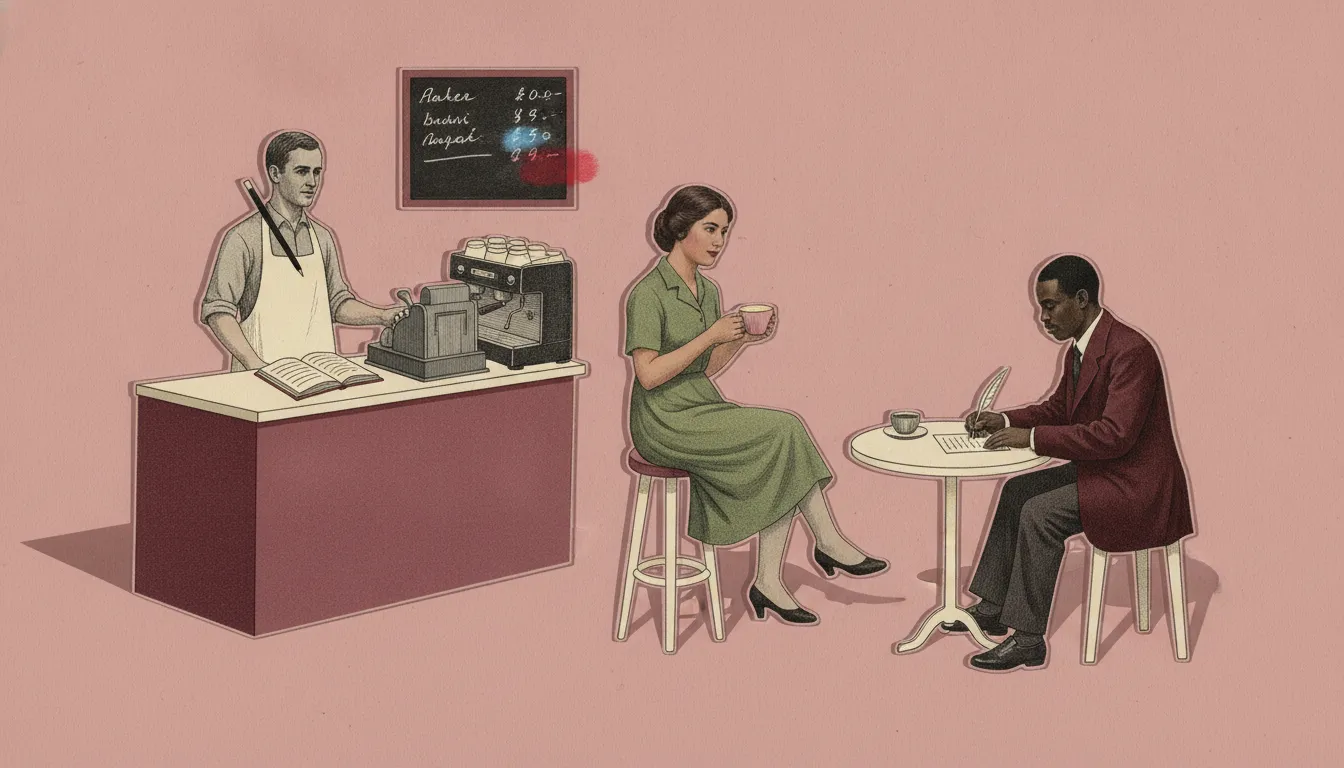
Gus changed one price a day. One, never two, because two was a trend and a trend was noise. He wrote the old price and the new one in a notebook by the till, and under them he kept a count of who noticed. Six years of notebooks. Nobody had ever asked what was in them, which was itself a number he kept.
Today it was the flat white. Twenty cents. He had rubbed it out on the board and written it back in the same hand, and then he had made twenty-three of them, and twenty-three people had paid and said thanks and gone to work.
The twenty-fourth was Nadia, who had got off the train eight days ago and had been in every morning since, on the same stool, with a flat white and a face that believed things.
"He was here yesterday," she said.
"He's here every day."
"Same table."
"Same table, same coffee, same thing."
The man in the corner had a coffee at his elbow and a single sheet of paper under his hand and he was writing on it, slowly, the way you write when you have already decided every word. He had come in, said morning, gone back out and smoked a cigarette by the door, come back in and sat. That was the order. It had been the order for the best part of a year.
"What's the thing?"
"A letter."
"To who?"
"An office. He said once. Some permit."
"Every day?"
"Writes one every day. Same letter, near enough. One paragraph. He showed me one time, I didn't ask. Very polite. Please issue a decision. Yours and so on."
"And sends it every day?"
"Sends one when they write back. The rest go in the jacket."
"Why write the ones he doesn't send?"
"Ask him."
Nadia looked at the man and then at Gus and then at the man again.
"And they haven't."
"They've got a screen. He says it tells him ninety-four per cent. Nearly there."
"Then he's nearly there."
"It's said ninety-four since March."
She drank her flat white. She did not say anything about it, and Gus wrote nothing in the notebook, and the count stayed at nought.
"He gave up," Gus said.
"He's writing a letter."
"That's what giving up looks like."
"Writing a letter every day to the same office is what giving up looks like."
"Yes."
"How."
Gus wiped the wand. He had told this before and it came out in the same order each time, which he was aware of, and which he let happen, because the order was the point.
"A year ago he sat at that table and shouted at his phone. Not every day. Enough. Face up on the table, waiting for it, and when it went he'd pick it up and you could hear him from the street. Then they moved him out of his place. Two weeks. Don't know who, don't know why, two weeks and he was somewhere else, and he came in here the morning after the move the colour of that cup. Then the place he worked wrote him up the week he came back. He told me that one. Then he was grey for a month. Grey, didn't eat, came in and didn't drink the coffee, just held it. Asked me about my back, that month. I'd done it in lifting the milk. Nobody else asked. Then one day he wasn't grey. Came in, said morning, went out, had his smoke, came in, sat down, wrote a letter. Been doing it since."
"He didn't say morning before?"
"Before he said nothing. Phone got all of it."
"And now he says it to you."
"Says it to me, says it to the hi-vis, said it to the dog last week. Dog wasn't his."
"That's not giving up."
"He stopped shouting."
"That's not the same thing."
"From here it is."
"From here he's writing a letter."
"Quietly."
"You want him to shout at it?"
"No. I'm saying he did, and now he doesn't, and something happened in between, and the something is giving up, because that's the only thing that turns the volume down like that. I've had this cafe six years. I've seen it. People come in loud and go out quiet and it's never because they won."
"Or they stopped needing to."
"Same thing."
"It isn't."
"Tell me the difference from the counter."
Nadia opened her mouth and shut it. Gus watched her do it with some satisfaction. It was the question he always got to, and nobody had ever answered it, and he had a count for that too.
The man in the corner finished the paragraph. He read it once. He folded the sheet in three and put it in an envelope he had brought with him, and he licked the envelope, which almost nobody did any more, and pressed it flat on the table with the side of his hand.
Then he brought the cup to the counter, because he always brought the cup to the counter.
He put the coins down. Twelve dollars and twenty cents. Gus looked at the twenty.
"Same tomorrow?" the man said.
"Same tomorrow."
And he went out, past the door, envelope in his jacket, and did not light another one, and was gone up the street.
Nadia had watched the coins.
"He paid twenty extra."
"He paid the price."
"You said twelve."
"That was yesterday."
"You didn't say it went up."
"Nobody says. It's on the board."
She turned and looked at the board. She found it. She looked at it for a while.
"You changed it."
"This morning."
"Why?"
"Prices change."
"Twenty cents."
"Twenty cents."
"And he knew."
"He always knows. Never says. Pays it, says same tomorrow, goes."
"Every time?"
"Every time I've changed it. I've got it written down."
She looked at the notebook then, the one by the till, and Gus saw her look and did not move it, because moving it would be a thing, and he did not do things.
"That's not a man who gave up," she said.
"That's a man who stopped arguing about twenty cents."
"That's a man who read the board."
"Everyone can read the board."
"Twenty-three people didn't. And twenty-three people didn't ask about your back."
"That was one time."
"It was the month he was grey. You said."
"I said."
"A man who gave up doesn't look up from it to ask about your back."
"Maybe he does. Maybe that's exactly what he does."
"Then why does he say morning to the dog?"
Gus did not answer that. He picked up the pencil, and under the two prices he wrote a one, and then, after a moment, a two, and the time.
Nadia put her own coins on the counter. Twelve dollars and twenty cents. She did not say anything about it either.
"Same tomorrow?" she said.
"Same tomorrow."
She went out. The stool turned a little on its own and stopped. Gus made the next one for a man in a hi-vis who paid with his phone and did not look at anything, and the count stayed where it was.
In the corner the table was empty, and the chair was pushed in, and tomorrow at ten past seven the man would come in and say morning and go out for the cigarette and come back and sit and write one paragraph to an office that would tell him he was nearly there. Gus knew that the way he knew the price of milk. He also knew that he still could not tell you, from the counter, whether it was the saddest thing he had ever seen or the other thing, and he had decided some time ago that he did not need to, and he wrote that down nowhere.
the cafe
till: close. 15:40.
flat white: 12.20 (was 12.00).
noticed: 2 of 41.
tomorrow: long black.