
Held
the 19
run 7. 07:41 off the terminus.
today: no wait.
thanks: 0 of 0.
Marg did not wait for runners on a Tuesday. She waited on a Monday and a Thursday and not on the others, and the days moved round once a month so nobody could learn them, and she had never told a soul which was which. She kept a notebook above the dash, the paper kind, because a phone was the company's and a notebook was hers. One line a stop. Who got on, who said thanks, whether she had waited. Three years of that. It was not much of a notebook. It was a lot of lines.
Teo stood at the second door. He always stood at the second door, because the second door was the one people ran for, and because standing there with his back to the pole he could see the stop coming and the next stop after it, and he liked to see what was coming.
The stop was Brunswick Road. The tram slowed, the doors folded open, two got off, four got on, and the chime went, and Teo saw her.
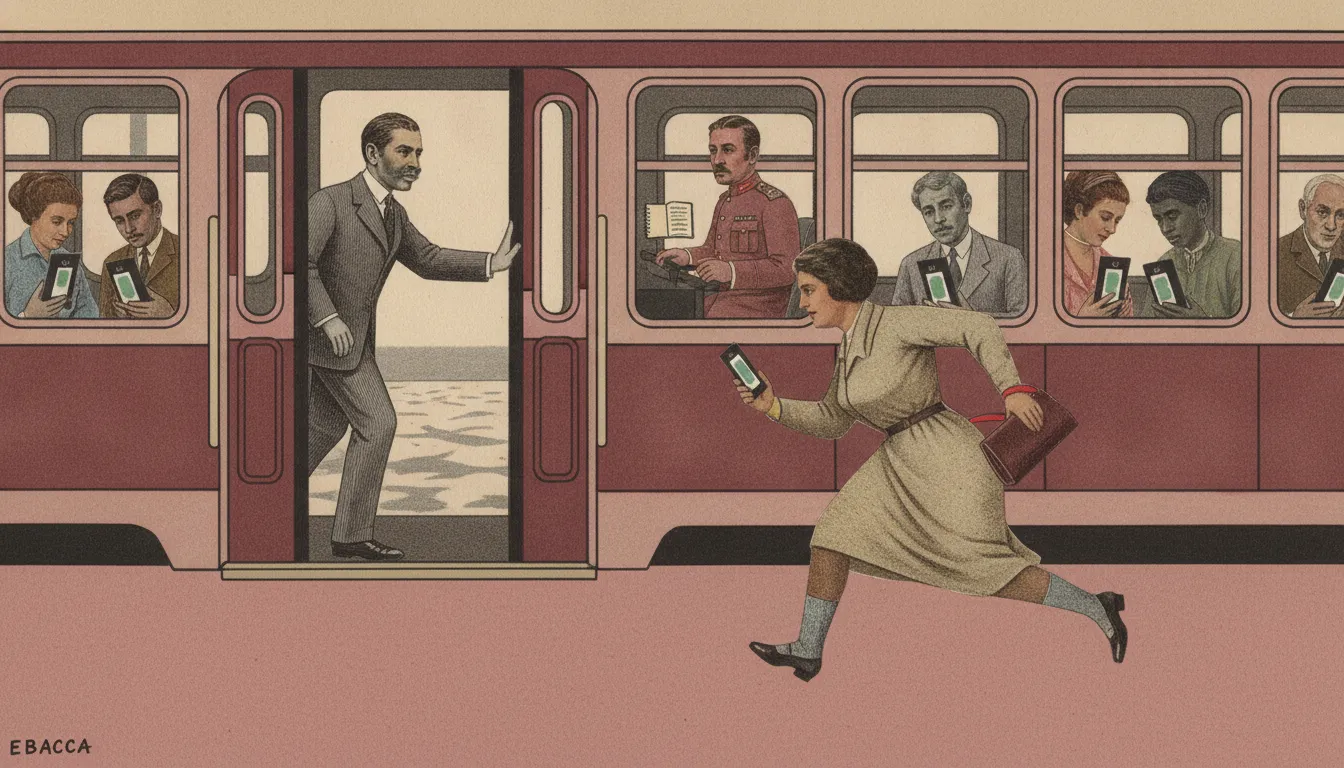
A woman with a bag, forty metres back, running the way people run for a tram when they have decided they are going to make it and have not asked the tram.
He put his foot on the step.
The door came in and met his shoe and stopped there and thought about it. The chime went again, longer. Up the car a man looked up from his phone and looked back down.
"Second door," said Marg, through the speaker, in the voice drivers use for the second door.
Teo did not move his foot.
"Second door, clear the door please."
"Someone's coming."
"I can see someone's coming."
"So."
"So the door's mine."
The woman with the bag made it. She came up the step past his knee with the bag against her chest and said "thanks, thanks" to him, to his face, and went down the car to find a strap, and Teo took his foot off, and the door closed, and the tram went.
He looked up the car at the back of Marg's head. She had the notebook open on the dash. She wrote one line.
He had a number as well. He did not keep it in a book. He kept it where he kept his phone number and the date his mother died, in the part of his head that did not need writing down. The number was how many of them held the next one. He held a door, somebody came through it, and then he watched what they did at the door after that, the shop, the office, the next tram, and the number was how many turned round and held. He had kept it since his twenties. He had never said it out loud and he was not going to start, because a number you say out loud is a number people argue with. It was not a good number. It had never been a good number. It was, in his private opinion, the only honest reading anybody had ever taken of this city, and nobody had asked him for it.
The tram stopped at Albion Street. Nobody ran. Nobody said thanks. Marg wrote a line.
At the lights before Blyth Street she turned round in the cab, which drivers did not do.
"You do that every Tuesday."
"Do what."
"The foot."
"If someone's running."
"Someone's always running. You do it on a Tuesday. Not a Monday."
"I don't know what day it is half the time."
"You know what day it is."
He did know what day it was.
"It's one person," he said. "She made it. Nobody died."
"It's not about her."
"Then what's it about."
Marg looked at him the way you look at a man who has asked a question he already knows the answer to, and then the light went green and she turned back round and drove.
The woman with the bag had found a strap. She was on her phone. She had not looked back at him once, which was normal, and which was not the part he counted. The part he counted was later.
Moreland Road. Three off, one on. The one said nothing, sat down, phone. Marg wrote a line.
"Three years," Marg said, to the windscreen.
"What."
"You've been on this run three years. Since they changed it. Same stop on, same stop off, same door."
"So have you."
"Thanks, driver. That's what you say. Every day, at Bell Street, getting off. Thanks, driver. Two words. Same two."
"It's polite."
"I've got it written down."
He looked at the notebook. He had seen it every morning for three years and had taken it for a timesheet.
"The days I wait for people," she said, "and the days I don't. You say it the same. Thanks, driver. Doesn't matter if I waited. Doesn't matter if I shut it on some poor cow with a pram. Thanks, driver. You're the only one who does."
"That's a good thing."
"It's a very useful thing."
He heard the word. He heard that she had picked it.
"Most people," she said, "say thanks when I wait and don't when I don't. That's fine. That's what the book's for. You say it either way. Which means you're not saying it to me."
"Who am I saying it to."
"I don't know. Your mum. The idea of a driver. Somebody who told you once. Not me. I could be anyone up here and you'd say it."
The tram slowed for Bell Street. His stop. He had the pole in his hand.
"And the foot," she said. "That's the same thing, isn't it. You're not holding it for her."
"I held it for her."
"You held it. She came through it. You'd have held it for anyone."
He had nothing to say to that because it was correct.
He had, if he was honest, known it for a long time. He had worked it out in his twenties, around the time he started counting, and the working out had changed nothing about the foot. He still put it on the step. He had known about himself exactly what he knew about the four who got on at Brunswick Road and said nothing and sat down and looked at their phones, that they were running a thing somebody had written for them, and the only difference he had ever been able to find was that he could tell you the thing's name. He had thought that was a difference. Standing at the second door with the stop coming he was no longer sure it was a difference you could spend.
The doors folded open.
He stepped down. He turned, the way he turned, and he looked up the car to the cab, where she was already looking at him in the mirror with the pencil in her hand.
"Thanks, driver," he said.
She wrote it down.
He stood on the footpath and the tram went, and he did not watch it go, because the woman with the bag had got off behind him, which she did not usually do, and was crossing toward the bakery with the glass door that stuck. A man was going in ahead of her. The man pushed the door and went through and let it swing.
She caught it on her hip, and went in, and it swung shut behind her.
Teo stood a moment longer. Then he put the number where he kept it, unchanged, and walked up Bell Street to work, and tomorrow was Wednesday, and he did not know yet whether it was a day she waited.
the 19
run 7. 08:12 at the depot.
today: no wait.
thanks: 3 of 61.
door held against: 1. second door. tuesday. as per.